
Slater Warrant Checks
Begin any Slater warrant check at Iowa Courts Online. The index shows public docket activity. It is not a live window into the Sheriff's operational warrant system. For what a court entry means, the Story County Clerk can explain it, while the Sheriff handles contracted local law-enforcement service for Slater.
- Search by full legal name or a known case or citation number and select Story County.
- Open the likely result and save the exact case number, filed charge, dates, and warrant-related wording.
- Call the Story County Clerk at (515) 337-8300 if an entry is unclear or may reflect old activity.
- Use Story County Sheriff non-emergency dispatch at (515) 382-6566 for appropriate Slater service routing.
- Send a focused chapter 22 request to the city, Sheriff, or court custodian that maintains the desired record.
A Slater warrant search that comes back empty proves little. Sealed, juvenile, delayed, and restricted law-enforcement records stay out of public view.
Slater Warrants and the Service Agreement
Slater gets its policing from a 2025 Story County law-enforcement agreement with the Sheriff's Office. That contract covers patrol, ordinance enforcement when the city asks, 24-hour E911 dispatch, detective services, inmate housing, and related support. So a Slater resident with a city law-enforcement matter can reasonably call the Sheriff. The agreement stops there, though. It creates no public warrant list, sets no standard bond amount, and gives city staff no power to say whether a warrant is still active. Those questions belong to the issuing court.
Key point: use the agreement to identify the local service agency, then use the court docket and clerk to verify the court record.
Policing and Courts in Slater
Slater runs no municipal police department of its own. The Story County Sheriff handles local law enforcement under contract, and Iowa has no separate Slater municipal criminal court. Traffic tickets, municipal infractions, misdemeanors, and felonies all move through the unified Iowa District Court system.
Story County Sheriff
1315 South B Avenue, Nevada, IA 50201
Non-emergency: (515) 382-6566
Records: (515) 382-7462
Use for contracted patrol, dispatch, Sheriff records, service, and operational routing.
Story County Clerk of Court
1315 South B Avenue, Nevada, IA 50201
(515) 337-8300
Use for Iowa District Court dockets, citations, payments, and public warrant-entry questions.
A judge or magistrate signs a warrant. The clerk keeps the case file, and an authorized law-enforcement agency serves the order. Slater City Hall does neither job.
Slater Warrant Questions by Custodian
One Slater case can touch three offices. Each holds a different piece of the record. Calling the right one keeps a court question away from city administration and a city-business question away from dispatch.
| Question | Likely Slater route | Limit |
|---|---|---|
| City administration | Slater City Hall | Not a criminal-court docket. |
| Patrol, dispatch, or Sheriff report | Story County Sheriff | Protected agency material may be withheld. |
| Case or warrant entry | Story County Clerk | The clerk cannot provide personal legal advice. |
| Immediate danger | 911 | Not for routine public-record research. |
The IOWA System sits apart from all of this. Authorized agencies use it, but it is not a public Slater warrant lookup by name.
Warrants in Slater: The Main Types
Match the exact label used in the Iowa court record. A citation, a summons, a warrant for arrest, a bench warrant, and a search warrant are not the same thing. Even the same Sheriff deputy may later handle the paperwork.
| Type | How it arises | Authority |
|---|---|---|
| Arrest warrant | A complaint or affidavit supports probable cause to arrest. | Iowa judge or magistrate |
| Failure-to-appear warrant | A required appearance is willfully missed in a qualifying matter. | Iowa District Court |
| Bench warrant | A court setting or judicial order is missed or not followed. | Assigned judge or magistrate |
| Search warrant | Sworn facts establish probable cause to search for specified evidence. | Judge or magistrate |
A search warrant targets evidence, not a wanted-person listing. And Iowa public sources do not treat "capias" as a Slater database term.
No Slater Warrant Roster Exists Online
Slater posts no online warrant roster. The city runs no municipal police search page, no most-wanted list, and no public warrant-recall form, and there is no city bond schedule to consult. Since the Sheriff handles law enforcement for Slater under contract, a resident might look to the county next. Story County publishes no public warrant table of its own. A blank search, though, is not the same as a clean record. Public dockets lag, and operational systems hold details the public never sees. An inmate roster will not fill the gap either, since custody and warrant status are two different facts. The workable path runs through Iowa Courts Online, the clerk, the Sheriff's non-emergency or records line, and a focused public-record request. Skip the commercial people-search and mugshot sites.
Slater Warrant Records: What They Show
A Slater court docket can carry case identifiers and later court actions. It may leave out affidavits, personal identifiers, confidential attachments, and current law-enforcement status.
| Case number | The official identifier, such as SRCR012345; use the exact displayed format. |
|---|---|
| County and court | Story County and the applicable Iowa District Court case setting. |
| Party and charge | The public name field and filed allegation or citation, subject to access rules. |
| Issuing authority | The judge or magistrate connected with the order, when shown. |
| Event dates | Complaint, issue, appearance, service, return, recall, or later docket dates. |
| Status wording | Issued, outstanding, served, returned, recalled, quashed, or sealed, as recorded. |
Copy the exact terms on any Slater docket entry and read the later ones too. An old warrant line can stay visible after a recall, while a fresh change may not have reached the public index yet.
Slater Warrant Service Is Not Status
The service agreement says who patrols Slater. It says nothing about whether a warrant is active today. That answer rests on the issuing court's order and what has happened in the case since.
- Service
- An authorized officer carries out a warrant or legal order under governing procedure.
- Active or outstanding
- A status suggesting that the warrant has not been served, recalled, or otherwise cleared, subject to official confirmation.
- Recall or quash
- A court action withdrawing or setting aside the warrant according to the exact order.
- Return
- An officer's documentation of execution or non-execution, not a complete summary of present status.
- Custody
- A person's detention status, which is distinct from whether a separate warrant exists.
The clerk can interpret the public docket. The issuing court sets the required response. The Sheriff answers operational service or custody questions, but the judge keeps the legal authority.
Slater Warrants and Story County
Slater's contract with the county makes the connection direct. The Sheriff handles contracted law-enforcement work, Iowa District Court issues warrants and related orders, and the Story County Clerk keeps the public docket. The IOWA System stays closed to anyone outside authorized agencies. For the wider county court and Sheriff framework, see Story County warrant records.
Warrant flow: Slater event or city request › Story County Sheriff service › Iowa District Court and Story County Clerk › authorized service and restricted IOWA System.
Slater Warrant Steps After a Missed Date
Missed a court date in Slater? Find the case number first. Then call the clerk or your lawyer. Ask whether the public entry is a warrant or another order, which judicial officer entered it, whether it is still active, and what step the court wants next.
- Ask whether a hearing, motion, bond, voluntary appearance, or other compliance is needed.
- Do not assume that payment alone recalls a warrant or completes every obligation.
- Keep a receipt, filed document, or signed court order after taking action.
- Ask when a recall or satisfaction should appear in the public docket.
Slater has no set surrender window, no local recall form, and no fixed bond amount. The service contract offers no shortcut around the issuing court. A lawyer can weigh the proper response and the custody risk.
Slater Warrant Routing at City Hall
Slater City Hall sits at 101 Story Street, and its official page posts the city administration and clerk line, (515) 685-2531, with weekday hours from 8:00 a.m. to 4:00 p.m. Those are municipal office hours only. They are not police-department or district-court hours, so plan any Slater warrant question around the right desk.
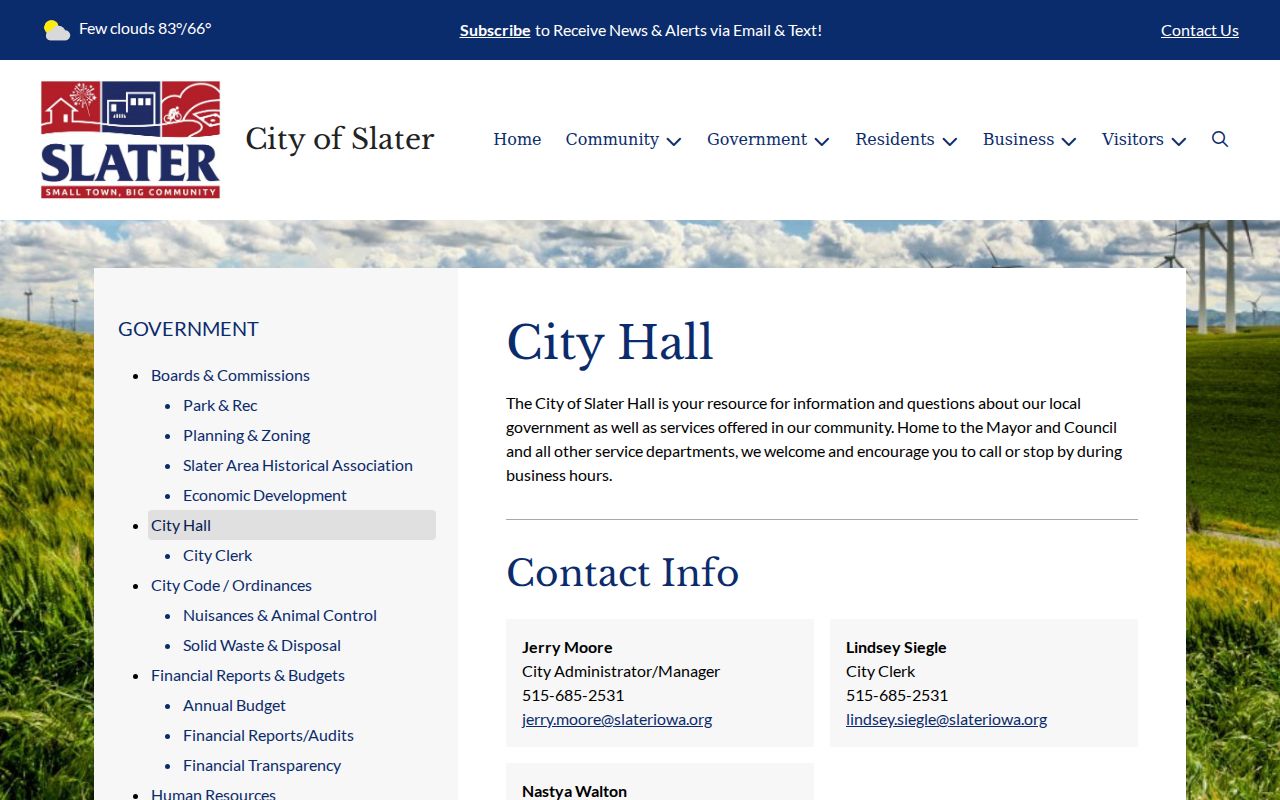
Know which office holds what before you walk in. Slater City Hall keeps the city's own administrative records, while a Sheriff report goes through the Sheriff's records channel and a warrant entry filed in court belongs to the Story County Clerk. Heading to the wrong counter just burns a trip. And when Slater's City Hall closes, emergency service does not: the E911 dispatch agreement runs 24 hours a day. Office hours, dispatch, records processing, and court availability all run on separate clocks, so call the labeled contact first.
Accessing Slater Warrant Records
Route any public-record request to the office that actually holds the file. Ask Slater for a city administrative document, the Sheriff for an agency report or service record, and the Story County Clerk for a filed court paper. Include the agency, a date range, a case or incident number if you have one, and a clear description of the record you want.
Key rules:
Iowa Code chapter 22 provides public-record access subject to exemptions and reasonable procedures.
Iowa Code chapter 804 governs core arrest-warrant issuance, content, and service rules.
Iowa Code chapter 232 limits disclosure of juvenile information.
Expect some material to stay out of reach. Active investigative files, sealed filings, protected victim information, and personal identifiers can be withheld or redacted. Ask Slater for the public portions that can be separated out, and for the legal basis of any denial. A refusal can mean the record is protected rather than missing, and no agency has to build a new warrant-status certification for you.